Following
unprecedented success in seeing wild Brown Bears on our 2013 tour, with a
minimum of 10 different individuals seen over the course of the week, and at
least one bear seen on each of the 11 dawn/dusk watches we made (all at one
site except for one evening elsewhere), I decided to change the formula and
include a significant ‘Plan B’. With over
60 butterfly species also seen in 2013, it was going to be interesting to see
how a tour in a presumably ‘normal’ year would work. It seemed logical that both
these high bear and butterfly figures were attributed (at least in part) to the
exceptional weather conditions in spring and summer, with a very cold late
spring and very fine mid- to late summer affecting flowering and fruiting,
which was not the case this year.
Given the different habitats and in consequence
food resources available for Brown Bears, I also wanted to explore the area of
the Alto Sil, a contiguous area to the Somiedo Natural Park in extreme southern
Asturias, which is most easily accessed from northern Castilla y León, so we
stayed the first two nights in Villablino. This would allow access to the
generally lower and less rugged mountains on more acid soils, in this area
which coincidentally has a strong tradition of mining.
So how did it go? The first difference this year
was the massed presence of mainly Spanish observers in Somiedo before we
arrived, making use of the latter part of the school summer holidays, and who’d
helped locate a few bears before we moved to the Natural Park. The next was that
two of the bears located in the region this autumn were females, each with 3
cubs! The third was that the extremely hot and dry conditions of 2013 were
replaced by still generally very warm and dry, but more variable conditions
this year, which to be honest were generally better, while the last involved a
‘problem bear’!
Meeting in Oviedo airport Santi and I soon loaded
up the vehicles and we headed S along the motorway, with the increasingly
rugged limestone mountains drawing more and more appreciative comments from the
group as we went. Turning W we had time for a short stop and leg stretch in
lovely warm conditions, mainly noting a few butterflies including Chalkhill
Blues, Iberian Marbled White, Comma and Mallow Skipper, plus a lovely burnet
moth species and several flowers, including the first of numerous hay meadows
housing drifts of Meadow Saffron, which we enjoyed throughout the tour. All to
soon we continuing to our hotel in Villablino and relaxing with plenty of time
for our first dinner and a good night’s sleep.
Clearly, watching most wild mammals in Europe is
no easy task and with around just 220 Brown Bears in the W Cantabrican
population, finding them requires time and patience. And this is why close
collaboration with the Fundación Oso Pardo, with their highly professional
wardens who are out in the field on a daily basis, is so important. Firstly, it
minimizes the possibility of being in the wrong place at the wrong time, such
as finding yourself too close to a bear and so disturbing it, as well as
maximizing our chances for seeing bears at all!
And so it was that after a not too early
breakfast the first full day, we greeted Luis, our FOP warden, and headed off
into the mountains for our inaugural watch. Shuttling us up a rough track in
the Land Rover saved a chilly early walk, but in the lee of the slopes and with
near perfect calm and clear conditions, it was actually not that cold at all.
Luxury! With hopes high and the adrenalin pumping we set about scouring the
slopes opposite for signs of animals… Very distant Southern Chamois were
spotted first, but then just when it seemed we were likely to draw a blank, a
brown shape appeared on the scree rubble among the scrubby slopes opposite. A
scramble for the optics and all the scopes homed in, and there, browsing
through the scrub in her search for bilberries, was a large female bear. Luis
smiled and quietly said it was ‘the’ female, so to our utter delight, moments
later the first of her three 8 month old cubs tottered out into view.

Osa con tres cachorros en Leitariegos / Female Brown Bear with three cubs at Leitariegos
Then the second, and finally the third. Not only that, but one of them was a silvery furred individual in certain light angles! We watched and watched, losing them from view from time to time, but a considerable time later, after having watched the youngsters playing as much as feeding, including two rolling over and over headfirst down the slope through the scrub, we finally lost them from view for good. A truly remarkable sighting and an unsurpassable start!
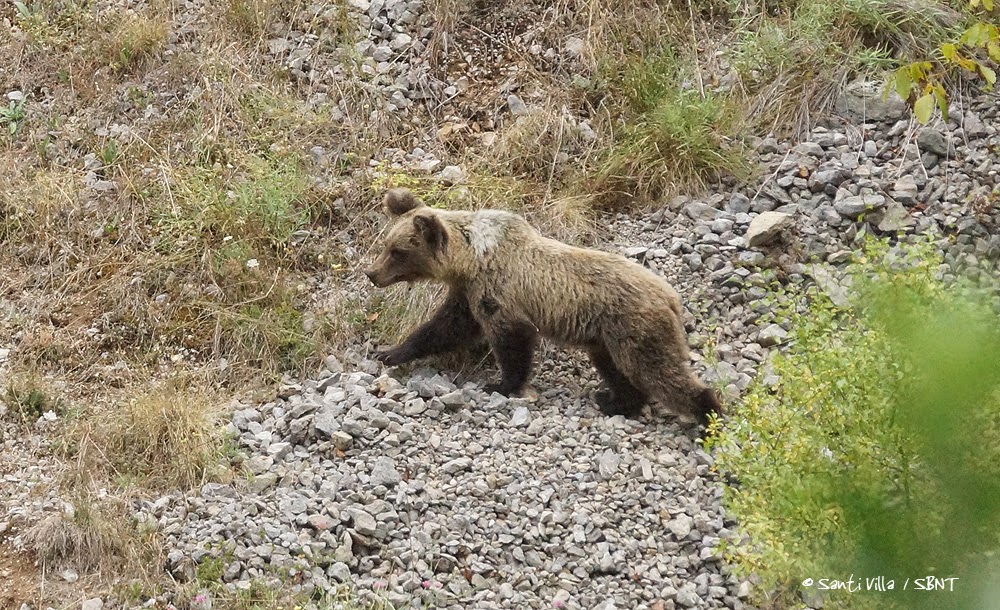
And this was just the first of the two females with three cubs that we saw. Another female with her three 18 month old offspring feeding on hazelnuts a short way above a village near Pola de Somiedo had been seen on and off for almost two weeks, and was remarkably consistent in appearances. Indeed the family afforded excellent views when we visited on two mornings, and even the last day when we returned for a last look, although they had disappeared, a black male appeared feeding in the bushes on the other side of the valley, which showed well instead! But in terms of close views, the other two singles we saw were exceptional. Firstly, our fifth individual of the tour was seen mid afternoon on the first full day as it walked and then ran down a scrubby valleyside, crossed pastures and a small river, before climbing up towards us through woodland and finally crossed over the road in front just 150m away.
The other individual proved to be an exceptional case. Having woken to poor weather and rain on our last day in Villablino, we decided to spend most of the day in and close to the Sil Valley. This allowed us to find a range of more lowland birds species typical of the pastures and meadows here, including Iberian Grey and Red-backed Shrikes, Whinchats, Northern Wheatears and European Stonechats, and on the edge of a village, a remarkable finch and sparrow field with European Serin, Eurasian Tree Sparrow and a flock of Rock Sparrows of most note. However, the Pola area appeared to be in a rain shadow, and once we’d passed to the N, took advantage of recent news of a young bear which was approaching a local village to feed on figs, apples and pears there, to take a look. Little was to prepare us for the scene which unfolded however, as arriving around 1630h there was no-one to be seen except for a local, roaring noisily up and down a track on his quad. Not exactly ideal bear-watching conditions! However, a mixed Belgian – French group of fathers plus boys (who we bumped into repeatedly during the trip) arrived shortly afterwards, and after noting a Western Spectre passing low over the water under a small bridge, we were suddenly ushered up into the village by a Natural Park ranger to an ‘adequate viewpoint’.
Unfortunately, this apple orchard was on a slope far too steep for some group members, so when the bear was accidentally flushed out of a hazelnut bush inside the village about 30 minutes later, we reassembled on the main road just below, along with numerous other watchers and both park and FOP wardens. And to our astonishment it reappeared immediately opposite in full view, allowing us plenty of time to enjoy watching it before it finally wandered down into scrub and out of sight.
With light rain appearing, most observers, like us, decided it was time to leave, so we headed down to the vehicles on the roadside below. But just as we were about to board, it was found in the river just a few metres below us! Pandemonium followed with a park warden trying to stop some people take pictures, while others headed for a small bridge nearby, presumably to try and intercept it as it headed upstream, so we immediately boarded and left. The novelty of being able to see a wild bear so close –which was failing to see humans as a potential threat and so keep its distance– and to even try and photograph and video it on mobile phones was leading directly to a potentially dangerous situation, both for the bear and the observers. The experience left us with a bitter-sweet feeling, but thankfully steps were put in place over the following couple of days and a concerted effort by the wardens meant both that observers kept their distance and the bear was finally dissuaded from approaching, apparently eliminating both the immediate threat and even potential future problems with a bear habituated to –the nowadays friendly– human presence.

Abejero europeo / Honey Buzzard


The mammals weren’t just restricted to Brown Bears though, with mobile groups and individuals of Southern Chamois noted on five days (with over 30 on three of these), a small group of Red Deer one afternoon, a ‘pair’ of Roe Deer which showed early one morning, and two separate sightings of Stoat one day. But our last full day also saw a stroke of luck. Having drawn a bear blank on the early morning watch at the main site where multiple bears had shown the previous autumn, just as we were leaving due to the mist rising up the valley, we noticed another small group of observers watching quietly over a non-bear area. Having looked here various times unsuccessfully the previous year I suspected they were watching something special, and indeed they’d just located a Wild Cat feeding in some meadows! We walked down in silence, and through the swirling mist had fine views of a lovely individual. So as not to disturb the finders though, once we were satisfied we were off and headed for a well-earned drinks break. Returning later, I decided to double-check a nearer section of the meadows from close to the road and instead of being on the far side as earlier, the cat was coming closer here! Tremendous views ensued in the glorious sunshine, and when a Red Fox appeared in the same fields shortly afterwards, some even briefly saw a live mole before it was wolfed down by the fox! With growing numbers of observers accruing along the narrow winding mountain road it was probably timely that it eventually sauntered off, scent-marking as it went, but at least we’d given something back to the FOP wardens and even Guillermo Palomero, president of the Foundation, who all appeared while we were there!
Apart from the magnificent mountain landscapes, generally good weather and wonderful food, both at the hotels and also in the various bars we stopped at for our midday lunch, the rest of the week was easily filled with a series of fairly short walking excursions. The butterflies were excellent again, starting in earnest on our first full day during a rather hot but generally rather quiet walk in a valley bottom near Villablino. Our first Green-veined and Small Whites, Clouded Yellows and Common Blues were ‘normal’ fare, but a Southern Grizzled Skipper was a good find and a few butterflies dashing around the treetops caught our eye. Indeed the moderate size and brown colouring was intriguing and with persistence we finally watched a fine perched Brown Hairstreak, even though it required being seen in the scopes as it sunned itself in the canopy of a small Ash tree! Sadly these disappeared all too soon, but two Purple Hairstreaks were also then noted following suit, plus our first Lulworth Skipper, which proved to be common throughout the tour. The hot mid-afternoon also drew out large numbers of Silver-washed and a smattering of Queen-of-Spain, High Brown and Lesser Marbled Fritillaries, plus numerous Scarce Coppers and our first Silver-spotted Skipper and Brimstone at a lovely roadside area covered in a flowering Senecio, though the various endemic Chapman’s Ringlets present were perhaps the stars of this show.

Aricia agestis / Brown Argus
Aricia artaxerxes / Mountain Argus
Thymelicus sylvestris / Small Skipper
A return to a wonderful section of road for butterflies we found in 2013 was slightly thwarted one day by the cloud suddenly rolling in (after we’d spent time over a very enjoyable lunch watching thousands of House Martins, plus Golden, Booted and Short-toed Eagles and Egyptian Vulture from the restaurant’s patio!), but even so produced Swallowtail, Turquoise Blue, Spanish and Mountain Arguses, an ‘on its last legs’ Esper’s Marbled White and several Black Satyrs as highlights. Another walk from Pola the following day, followed by a beautiful drive and short walk in a nearby valley produced a Large Skipper, our first Sooty Copper and Lang’s Short-tailed Blues, plus Adonis Blue, several Berger’s Clouded Yellows, brief Large Wall Brown and Wall Brown, plus our first Marbled White and Rock Grayling too!
The final afternoon was also spent walking a lovely track in a gorgeous valley, and apart from the abundant butterflies in the adjacent meadows, the groups of blues and arguses coming down to sup salts from the road were a delight to see. While these were mostly Chalkhill Blues, Mountain Arguses were frequent and with patience we also picked out a couple of lovely male Baton Blues. The adjacent meadows were also rich in species, including a rapidly passing Large Tortoiseshell and another Lesser Marbled Fritillary, which along with the latter blue were all new species for this tour and not seen in 2013, while other notable species included Red-underwing Skipper, Blue-spot Hairstreak, Spanish Brown Argus, Large White, Small Tortoiseshells, Knapweed and Dark Green Fritillaries and Great Banded and Rock Graylings.
Other insect highlights included a meadow with around 15 lovely Forester Moths feeding on knapweed flowers, a few lovely 6-spotted burnet moths Zygaena transalpina, colourful Jersey Tigers and a couple of Hummingbird Hawkmoths. Dragonflies were fewer than last year but still included a few Common Goldenrings, Moorland Hawkers and Yellow-winged Darters. The numerous grasshoppers included blue- and red-winged species, plus lovely Rattle Grasshoppers, plus impressively large Great Green Bush-cricket and Wartbiter, while one potato crop had also been blighted by the infamous Colorado Beetle.




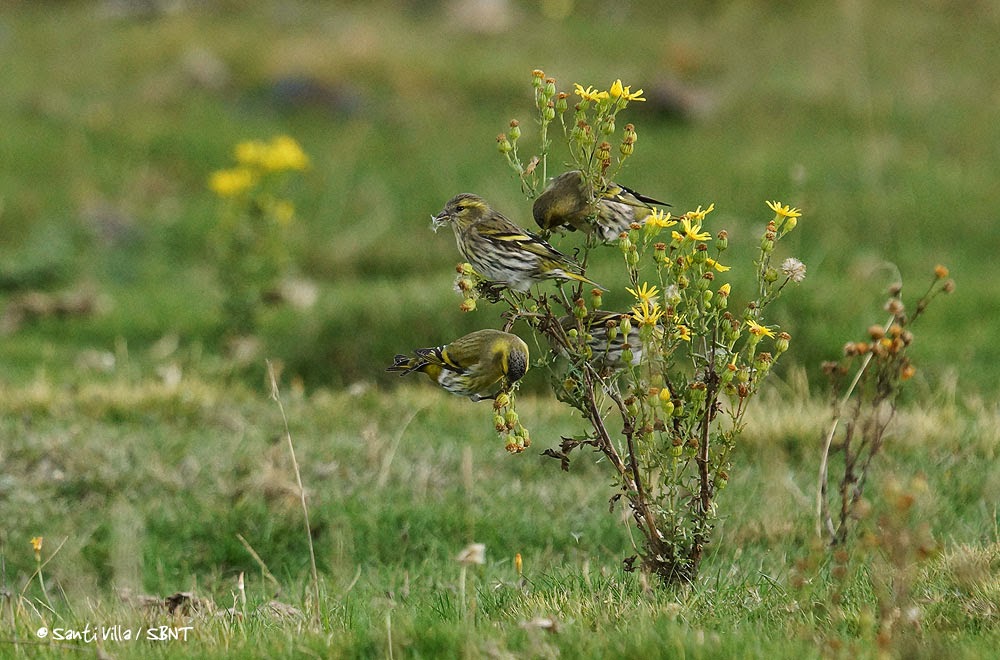
The bird life was very much as expected, being a typical mixture of species of these mountains, from the higher tops to wooded valleys, plus a few migrants. ‘Big bird’ highlights included a single White Stork high on passage, a few European Honey Buzzards amongst the innumerable Common Buzzards, several Egyptian and abundant Griffon Vultures, a few Short-toed Snake Eagles daily, Eurasian Sparrowhawks almost daily, Golden Eagles on three occasions and three single Peregrines. A few Common Swifts were still around, a surprise Common Kingfisher flashed up along a valley for the front vehicle, a lovely Wryneck gave us the run-around before finally feeding out in view, a few Iberian Green Woodpeckers were seen as well as heard, while plenty of Red-billed during the week and a large flock or two of Alpine Choughs one day up high were excellent. Indeed the latter site also provided a few persistent members of the group with stunning views of a close Alpine Accentor, after only brief flight views for most before. Northern Spain is an interesting mix, combining classicly ‘Mediterranean’ with more northern species and so the combination of Marsh Tit, Eurasian Crag Martin, Iberian Chiffchaff, Spotless Starling (though very localised here!), Black Redstart, Whinchat, Northern Wheatear, White-throated Dipper, Grey Wagtail, Tree and Water Pipits, Yellowhammer, Rock and Cirl Buntings is a fun one!
Santi and I would like to thank you all for making this such a fun tour. The excellent good humour throughout meant it was a real pleasure to lead, and judging from the feedback was very enjoyable, as we hoped! It is also timely to thank the Fundación Oso Pardo for their support during the tour, particularly to Luis Fernández, Guillermo Palomero and Marcos Simón in the field, plus Fernando Ballesteros both at the ‘problem bear’ site and also of course during the talk he gave on behalf of FOP covering numerous aspects of the Brown Bears, their biology, behaviour and conservation in the Cantabrican Mountains. Also to our hosts in both Villablino and Pola de Somiedo for attending to our requests and needs willingly and with unfailing good humour at sometimes slightly unsociable hours.
Text by John Muddeman / Photos by Santi Villa
Resumen en castellano
Hace no mucho tiempo la observación de un oso pardo en la cordillera era privilegio de tan sólo unos pocos. Su escasez, su comportamiento esquivo, y sobre todo, el desconocimiento de sus hábitos hacía que los encuentros con un oso fuera más producto del azar que otra cosa. Las cosas han cambiado en los últimos años, y al aumento de sus efectivos, debido en buena parte a la tolerancia y mayor comprensión con el plantígrado en los núcleos rurales donde aún sobrevive, debido en buena parte a la labor realizada por la Fundación Oso Pardo, junto con la posibilidad real de observarlos (normalmente a distancia) en libertad desde determinados puntos del Parque Natural de Somiedo, han generado un "boom" entre los amantes a la naturaleza poco habitual en nuestro país.
La observación de oso pardo puede mirarse desde muchos ángulos y bajo opiniones diversas, seguramente todos con sus razones, pero lo que no cabe duda es que ha contribuido a la propagación de su admiración, fundamentalmente en sus círculos más próximos... y por extensión a su conservación.
A finales del pasado mes de agosto, Spainbirds Nature Tours viajó al Alto Sil y a Somiedo con un grupo de británicos apasionados por la naturaleza con la intención de tratar de observar al oso pardo en libertad. El balance no pudo ser más positivo, once individuos vistos en ocho días de campo. Dos grupos familiares de cuatro (tres cachorros del año con su madre), y tres ejemplares diferentes, de diferentes edades, y en lugares diferentes, completaron el sueño de muchos de ellos. Agradecemos la colaboración brindada por la Fundación Oso Pardo, en particular a su presidente Guillermo Palomero, y a uno de sus guardas, Luis, por transmitir el cariño y respeto por la vida salvaje de la cordillera en la jornada que compartió con nuestro grupo.
Os dejo con algunas instantáneas comentadas tomadas durante la excursión. Como veréis ésta no fue una excursión exclusivamente centrada en localizar osos pardos, de hecho el título del viaje fue: osos pardos, mariposas... y aves.
Curiosamente los primeros osos observados no fueron en Somiedo, sino en la comarca leonesa del Alto Sil. La mañana del segundo día tuvimos la suerte de observar a primera hora un grupo familiar formado por una hembra y tres cachorros, uno de ellos mostraba un pelaje llamativamente plateado en su dorso.
Justo antes de comer ese primer día nos topamos con uno de los pocos abejeros que a la postre veríamos durante toda la semana.
Después de comer nos dirigimos a un paraje natural cercano a la localidad de Caboalles de Arriba. Omitiremos el nombre donde localizamos a un precioso ejemplar de oso pardo a las 16:30 h. justo cuando más calor hacía. El animal parecía que acababa de tener un baño refrescante en algún río cercano. La observación fue completamente fortuita... ¡En realidad nosotros íbamos a ver mariposas! Cinco osos en un sólo día...